


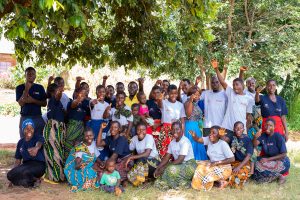
 When Alinafe stands before the small office block at Kanolo One Primary School in Ntchisi District, Malawi, she is looking at something she helped will into existence. A few years ago, she was a student who fell pregnant, left school and married. Today she chairs a thirty-strong youth group that built that office and the girls’ changeroom beside it, runs her own small business, and helps look after elderly women who have no one else. Her journey, and that of the young people around her, is not the story of a single project activity. It is the story of how several strands of CODE and FAWEMA’s iHEARD project, co-funded by Global Affairs Canada, met the initiative of young people themselves and, together, produced change that reached from individual lives into the wider community.
Before iHEARD: dependence, dropout and early marriage
The young people who would form the Kanolo One Youth Group began from difficult and familiar circumstances. Mary married at fifteen and, by her own account, returned to the marriage four times despite repeated efforts to dissuade her. Shiela also married at fifteen; Lester married at seventeen after becoming pregnant and once fled into the forest rather than be separated from her husband.
Around them, early marriage, teenage pregnancy and school dropout were common; the area’s senior chief describes them as long-standing concerns. What these young people shared was a shortage of reliable information about their bodies and rights, interrupted education, economic dependence, and few visible alternatives to the paths they were already on.
Exposure and engagement: where iHEARD came in
Change began with exposure to information they had rarely encountered openly. Through activities and the listening groups supported under iHEARD, members heard discussions of child marriage, contraception, child spacing, sexual and reproductive health rights, and the cost of leaving school early. In the schools, the head teacher of Kanolo One describes iHEARD strengthening three existing clubs rather than creating new ones, using music and other creative arts to carry messages on puberty and adolescence, with fixed meeting days that themselves helped draw learners back into class. He singles out the club guide as the most useful resource, because the clubs’ work spread into the community through peer encouragement.
Exposure alone did not change behaviour. Mary heard the warnings and still returned to her marriage four times. What converted information into decision was the chance to engage: to hear the same messages again among peers who were questioning similar choices, and then to act on them together. For most members, that meant joining the youth group in 2023.
Individual change: knowledge, confidence and healthier choices
As members engaged, the first changes were personal. They describe gaining a clearer understanding of contraception, child spacing and their own rights, and the confidence to act on it. Alinafe links the group directly to her own fertility decisions: “Without this group I could have more children by now. We learnt about child spacing.” Shiela describes the turn inward that preceded her decision: “After some thinking, especially because I felt sorry I was too young for marriage, I decided to join the group.” Members grew more willing to seek help and to make deliberate choices about pregnancy and relationships.
These self-reported changes are echoed by those who observe the community from outside the group. The head teacher reports no recorded pregnancy at the school in two years, and notes that young people now seek pregnancy-prevention measures, if at times discreetly, and discuss sexual health more comfortably than before. The senior chief observes that girls are now able to talk openly about sexual and reproductive health.
And the demand these young people developed met a supply: the district youth friendly health services coordinator reports that iHEARD improved young people’s access to SRHR services, partly by bringing services closer through BLM outreach, and that health surveillance assistants were trained in youth-friendly approaches, narrowing a long-standing gap in how providers met adolescents. Knowledge of child spacing and rights did more than improve health: it created room to imagine returning to education and investing in work rather than early and repeated childbearing.
Household change: new decisions, new footing
The individual changes reshaped households. Members began making different decisions about childbearing and discussing them with partners. Alinafe’s household shows the shift: she runs her own small business while her husband buys and sells crops. “My husband is also supportive,” she says. It is a more balanced household economy than the dependence many had known. Mary speaks of a new standing within her own home: “I am now more independent than before, and I am not looking back.” Across these households the common thread is reduced vulnerability: young people planning their families, contributing economically, and making decisions that were previously made for them.
Economic empowerment: livelihoods, savings and reduced vulnerability
Economic activity is where the group’s knowledge became tangible, and where members found the independence that underpins much of the rest. They started with whatever they could manage. Mary began with a single chicken and now keeps four. Shiela invested in poultry, lost the flock to disease and, rather than give up, taught herself to bake while rebuilding her chickens. Lester sells bananas and belongs to a separate savings and loans group. Alick combines farming with a small fried chicken business. As a group, they pooled weekly contributions, growing shared assets from three chickens to seventeen and establishing seven beehives, and some are now seeking vocational training and linkages with the National Economic Empowerment Fund. The significance of this income is not only material. Lester draws the link the group makes repeatedly: economic independence reduced the pressure towards transactional relationships and early or repeated marriage and gave members the standing to make their own choices. This is the point at which livelihoods, health, and agency reinforce one another.
Young people who convened the chiefs
What most sets Kanolo One apart is the direction in which influence flowed. These are young people in their teens and early twenties, several of them young mothers, who did not wait to be helped. Having gained knowledge, confidence and a measure of economic security, they identified what their school and community needed and then went to the people with the power to act and moved them.
The clearest instance is the school infrastructure. Recognizing that girls had nowhere private to manage menstruation, and that the school had no office of its own, the group resolved to build a changeroom and a teacher’s office. They financed the work from their own weekly contributions and provided the labour themselves, alongside mother groups, without hiring an outside builder. But they understood that a youth group’s savings alone would not stretch far enough, so they convened the area’s traditional leaders to make the case. As Alinafe recounts: “We briefed the chiefs about the change room during one of our meetings. They provided us with bricks for the projects. All the chiefs in the area supported us.”
Consider what that involved: a group of young people, several of whom had themselves been pushed out of school by pregnancy or marriage, calling the guardians of customary authority together, presenting a plan, and persuading them to commit resources. The chiefs did not instruct the youth; the youth set the agenda and led the chiefs into action.
Building the conditions for girls to learn
The group’s contribution to education is its most striking because of who is making it. Several members, Alinafe among them, have not yet returned to school themselves; young children and early marriages have, for now, closed that door. Yet these are the very people who have built the conditions for the next cohort of girls to stay in class.
Take the change room. For girls reaching puberty, the absence of a private, decent place to manage menstruation at school is a quiet but powerful driver of absence and dropout. By building one, the group removed a barrier that had nothing to do with ability or ambition and everything to do with dignity, making it easier for younger girls to remain in school every week of the month.
The office matters for a different reason. The school had no office of its own; teachers prepared lessons and held their meetings in their own homes, or in classrooms after the pupils had gone home. The structure the group built gives teachers a base, and it has expanded the school’s usable learning space: children who would otherwise be taught in the shade of a tree now have a room. A youth group has added to the physical capacity of a public school.
The head teacher places these contributions within a wider set of education gains he attributes to iHEARD’s work in the school. He describes a clear fall in dropout and learners returning, including after pregnancy; improvements in attendance, confidence and public speaking among girls; pupils who won a competition in Lilongwe; and younger children now able to read with the help of donated books. The community is less willing to let an early marriage be the end of a girl’s schooling.
A shift in what the community expects
Beyond the school gate, the group’s example and the chiefs’ authority have begun to move community norms. On protection, the chiefs have passed and enforced by laws against early marriage, and enforcement is real rather than nominal: Mary’s parents were fined two goats for allowing her to marry while underage. The group’s contribution here is direct as well as exemplary: members report that at least six early marriages in the area have been ended or prevented through their efforts, and that those young people are now members of the group themselves, drawn out of, or away from, marriage and into a circle of schooling, savings and mutual support.
The senior chief reports that girls now form their own clubs, take leadership roles, perform drama on sensitive subjects, and are willing to report abuse, including when teachers proposition them. He notes too that the area has been recognized among the best-performing in reducing gender-based violence, and that parents are increasingly willing to discuss sexual health with their children. None of this is the work of one youth group alone. But the group’s advocacy, its visible discipline, and the example of former child brides now leading community projects are threads in a wider change in how this community treats girls’ education and child marriage.
“For the past three years, since iHEARD, girls’ enrolment has risen and there has been a reduction in teenage pregnancy and in school dropout.” Senior traditional leader, TA Nthondo
What had changed was less a set of activities than a set of relationships. Young people who had once been spoken about in community meetings were now speaking in them; when Alinafe and her group sat down with the chiefs, they did so as participants in local decisions. The chiefs, in turn, were working to prevent early marriage rather than only to respond to it; writing and enforcing rules meant to keep children in school. Schools, parents and traditional leaders had drawn closer to the young people themselves, and a firmer expectation had settled in: that girls belong in class, and that early marriage is the community’s business to prevent. Responsibility for the wellbeing of adolescents was beginning to be shared rather than left to families alone. iHEARD helped create the conditions for this shift; it was the young people who occupied the space it opened.
___________________________________________________________________________________
This article is an adaptation of one originally published by Impala Insights as part of iHEARD’s endline evaluation. It draws on a focus group discussion with fifteen members of the Kanolo One Youth Group and on individual interviews with members whose accounts illustrate particular themes, with corroboration from the head teacher of Kanolo One Primary School, the senior traditional leader of TA Nthondo, and the district youth-friendly health services coordinator.