


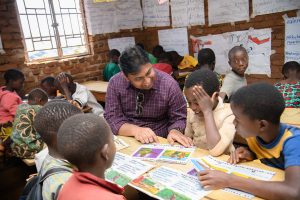
Recently, I had the privilege of visiting several schools in Ntchisi, Malawi, as part of CODE’s Let’s Read Ntchisi project. Having worked in the education sector for many years, I have always found time spent in classrooms to be among the most valuable opportunities to learn, reflect, and witness firsthand the dedication and resilience of teachers and students. My experience in Ntchisi was no exception.
Let’s Read Ntchisi is a two-year initiative working with 11 schools to strengthen foundational literacy for children in Standards (grades) 3 and 4, a critical stage when many children in Malawi begin to fall behind or leave school altogether. Together with our local partner, the Forum for African Women Educationalists Malawi (FAWEMA), the project is taking a holistic approach: recruiting auxiliary teachers to ease severe teacher shortages and overcrowding; providing teachers with training, coaching and opportunities for peer learning; putting thousands of locally relevant books and learning materials into classrooms; creating vibrant, print-rich learning spaces; and engaging parents and communities in supporting children’s education.
Walking into the classrooms of Ntchisi, I was immediately struck by the remarkable dedication and creativity of teachers. Despite working with very limited resources, they had transformed their classrooms into vibrant spaces filled with opportunities for learning. They were actively applying what they had learned through the project, using locally available and low-cost materials to create teaching and learning resources. Their innovation and resourcefulness were truly inspiring — a powerful testament to the creativity and commitment of teachers working with what they have.
Classroom walls were alive with letters, words, student work, storybooks and learning materials that surrounded children with literacy every day. These vibrant, text-filled spaces turned every corner of the classroom into an opportunity for learning, offering children constant exposure to language and helping them strengthen their literacy skills in meaningful ways.
The impact of these efforts was clearly visible. During classroom observations and interactions with students, I witnessed encouraging improvements in reading ability. Children participated actively in lessons, read with growing confidence and demonstrated genuine enthusiasm for learning. Many eagerly volunteered to read aloud, answered questions confidently and supported one another during classroom activities. Their energy and excitement were contagious. These moments served as a powerful reminder that when teachers receive the right support and encouragement, children flourish.
Yet, alongside these inspiring achievements, I encountered a reality that was difficult to ignore.
In several classrooms, students had no desks or benches. Many sat directly on bare floors, often without even a mat beneath them. Writing became an enormous challenge as children balanced their exercise books on their laps while trying to complete classroom activities. Watching children struggle to write under such conditions was heartbreaking.
Seeing this, I realized how challenging it must be for children to learn and write while sitting on the floor for hours every day. And still, despite these challenges, the children’s determination remained unwavering.
They come to school with smiles on their faces.
They eagerly raise their hands to answer questions.
They dream of becoming teachers, doctors, nurses and leaders.
They aspire.
They persevere.
One thing became abundantly clear during my visit: these children do not lack potential. What they lack are some of the basic resources that many of us often take for granted.
Their resilience, enthusiasm and commitment to learning were deeply inspiring. The teachers are doing extraordinary work, and the children are responding with remarkable enthusiasm and progress. Given their determination, one can only imagine how much more these children could accomplish with access to proper desks, benches and a supportive learning environment.
As I left Ntchisi, I carried with me both admiration and hope. Admiration for the dedicated teachers and resilient children who continue to achieve so much with so little, and hope that together we can do more to ensure that every child has the opportunity to learn in a safe, supportive and dignified environment.
I also left with a deep sense of gratitude. Let’s Read Ntchisi receives no government funding; it has been made possible through the generosity of foundations, teachers’ and community associations, and individual donors in Canada. Their support is reaching far beyond the provision of books or classroom materials. It is helping teachers strengthen their practice, bringing additional educators into overcrowded classrooms, engaging communities in their children’s learning, and creating better conditions for children to develop the literacy skills that can shape the course of their lives.
To everyone in Canada who has helped make this work possible: thank you. The classrooms I visited in Ntchisi are a powerful reminder of what that generosity looks like on the ground — in the hands of a child opening a book, in a teacher trying a new approach, and in a classroom increasingly filled with opportunities to learn.
The children of Ntchisi have dreams, and they are working tirelessly to achieve them. They deserve every opportunity to learn, grow and succeed.