


 Picture a Grade 5 classroom in Tarkwa Nsuaem three years ago. A student stares at a page, sounding out the words one by one, but the meaning slips away before she reaches the end of the sentence.
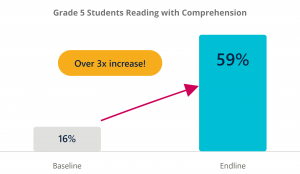
Thanks to you, today, that same classroom looks different. Reading comprehension among Grade 5 student across 37 Reading Ghana project schools jumped from just 16% at baseline to 59% at endline, meaning the majority of students are now not just reading words, but understanding them.
That’s nearly three in five children, up from fewer than one in five just three years ago. It’s strong proof that this approach, and your support behind it, is genuinely changing outcomes for kids.
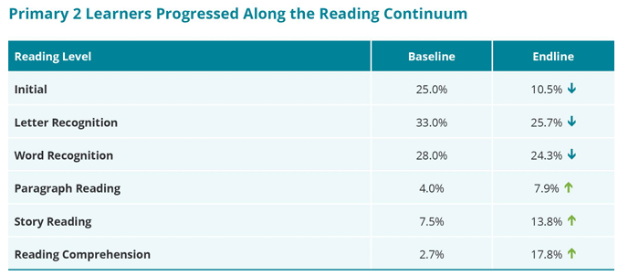
This progress reached the youngest learners too. Among Grade 2 students in project schools, reading comprehension rose from just 3% at baseline to 18% at endline. This six-fold improvement is giving these children a strong foundation as they move up through school.
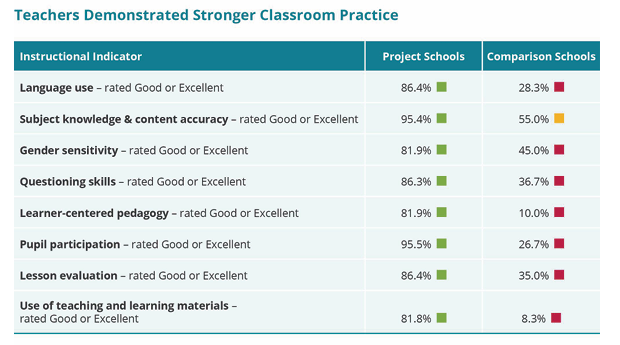
None of this happened by accident. Over the course of the project, 313 teachers received training, coaching, and mentoring in phonics instruction, guided reading, and how to support struggling readers. Coaches visited classrooms again and again, and teachers responded, using more group reading activities, stronger phonics instruction, and better classroom materials to reach every learner. Over 15,700 children benefited from this improved teaching, and the results show in their reading scores.
Reading clubs became a cornerstone of this work too, with 74 clubs established in schools. In these clubs, kids read aloud, play spelling games, and tell stories, building confidence outside the walls of a formal classroom. And it’s working: children who took part in reading clubs were far more likely to read with comprehension than those who didn’t (74% compared to 24%).
To keep great books in kids’ hands, more than 40,380 books and supplementary readers were distributed across project schools, including locally published Ghanaian stories that reflect learners’ own lives and experiences.
As one student put it during the evaluation, reading can take you places and help you do everything you want to do, and help you learn. It’s exactly the kind of confidence this project was built to create, and the gains held for both girls and boys, with girls in project schools achieving a 56% comprehension rate, on par with or ahead of their male peers.
Perhaps most encouraging of all is what happens next. As this phase of the project wraps up, local educators and officials are stepping in to carry the work forward. Ghana Education Service staff have already started using CODE’s literacy strategies in schools beyond the original 37, and district leaders have taken notice of the change.
As Catherine Andoh-Mensah, Municipal Director of Education for Tarkwa-Nsuaem, put it, her municipality has seen real, lasting improvement in education quality over the past three years, an achievement she credits directly to this partnership.
A jump in reading comprehension from 16% to 59% is the difference between a child guessing words on a page and a child understanding a story for the first time. It’s a teacher who now knows how to reach a struggling reader, and it’s a classroom that finally has enough books to go around.
None of it would have happened without you. Thank you for helping give these children a foundation that will stay with them for the rest of their lives.